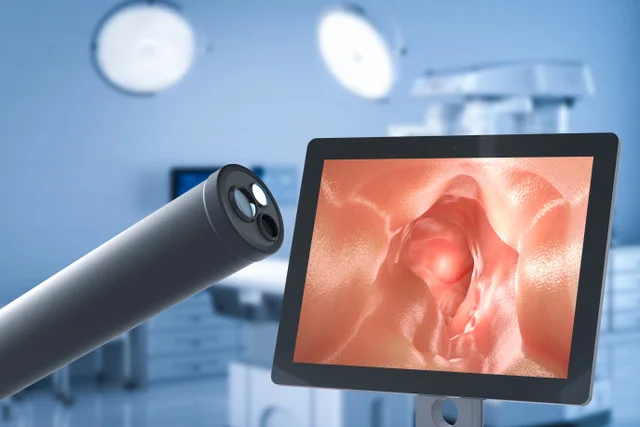
- Examines
- The entire colon and rectum
- Procedure time
- About 20–30 minutes
- Prep
- Clear liquids and a bowel prep
- Back to normal
- The next day
What is a colonoscopy?
A colonoscopy lets your gastroenterologist examine the full length of the large intestine — the colon and rectum — from the inside. It is done with a colonoscope: a thin, flexible tube with a light and a high-definition camera at its tip that sends a magnified image of the bowel lining to a monitor.
Through the same instrument, your physician can remove polyps, take small tissue samples (biopsies) and treat sources of bleeding, all in a single procedure. That is what sets colonoscopy apart from other colorectal cancer screening tests: stool tests and imaging can only suggest a problem, while a colonoscopy can find it and remove it in the same visit.
At SCDC, every colonoscopy is performed by one of our gastroenterologists, in a center designed for endoscopy, with sedation given by a separate anesthesia provider.
Why you might need one
Colonoscopy is used both to screen people who feel perfectly well and to investigate symptoms. Your physician may recommend one for:
Routine colorectal cancer screening, starting at age 45 for adults at average risk
A positive stool-based or blood-based screening test, which always needs a follow-up colonoscopy
Rectal bleeding, or blood in or on the stool
A lasting change in bowel habits — diarrhea, constipation, or a feeling that the bowel does not empty completely
Abdominal pain, cramping or bloating that does not go away
Unexplained weight loss, fatigue or iron-deficiency anemia
Follow-up after polyps or colorectal cancer, or monitoring of Crohn’s disease or ulcerative colitis
When to start screening, and how often
Colorectal cancer is being found more and more often in adults under 50 — it is now the leading cause of cancer death in younger men and the second in younger women. For that reason, national guidelines now recommend that adults at average risk begin screening at 45 rather than 50.
“Average risk” means no personal history of colorectal cancer or polyps, no Crohn’s disease or ulcerative colitis, and no parent, brother, sister or child who has had colorectal cancer or polyps.
If your colonoscopy is normal and your risk stays average, you will usually not need another one for ten years. People with a family history, inflammatory bowel disease, an inherited condition or previous polyps often need to start earlier and return more often — your physician will set an interval that fits your history.
Why quality matters
Not every colonoscopy is equally thorough. The best-studied measure of quality is the adenoma detection rate (ADR): the share of a physician’s screening patients in whom at least one adenoma — a precancerous polyp — is found and removed. Physicians with higher detection rates remove more of these polyps, and their patients go on to develop fewer colorectal cancers.
SCDC reports its colonoscopy quality measures — adenoma detection rate, withdrawal time and bowel prep quality — to GIQuIC, the national gastroenterology quality registry, and reviews them every quarter. Your part is the prep: a thorough prep is what lets your physician see the whole colon clearly.
Screening, diagnostic or surveillance?
The procedure is the same in every case, but the reason it is done decides how it is classified — and that can change what your insurance pays.
-
Screening colonoscopy
For people 45 and older with no symptoms and average risk. The aim is to find and remove precancerous polyps before they cause any problem. Repeated every ten years if the exam is normal and your risk stays average.
-
Diagnostic colonoscopy
For people with symptoms — bleeding, a change in bowel habits, ongoing abdominal pain, unexplained weight loss or fatigue — or to follow up a positive stool or blood-based screening test.
-
Surveillance colonoscopy
For people who have had polyps removed or have been treated for colorectal cancer, and for some patients with Crohn’s disease or ulcerative colitis. These are done more often than every ten years.
Paying for your colonoscopy
Most insurance plans cover a screening colonoscopy for adults 45 and older at no cost to the patient. That can change if a polyp is found and removed during the exam, if the colonoscopy is diagnostic or surveillance, or if it is done sooner than your plan’s screening interval. In those cases a deductible, copay or coinsurance may apply.
The surgery center, your physician and the anesthesia provider bill separately, so you may receive more than one statement. Plans differ, so we recommend checking with your insurer before your procedure — our billing office will also give you a written estimate in advance, and a single bundled price if you are paying for yourself.
How to prepare
A clean colon is the most important part of the procedure that you control. If stool is left behind, small polyps can be missed and the colonoscopy may have to be repeated. Your SCDC prep instructions are timed to your appointment — follow them exactly, and call the nurse line if anything is unclear.
Your prep may begin up to 36 hours before your procedure, so read your instructions as soon as you receive them. The outline below shows what to expect.
-
7 days before
Read your prep instructions and pick up your prescribed bowel prep from the pharmacy. Arrange for a responsible adult to drive you home. Review your medications with us — blood thinners, iron, diabetes and GLP-1 medications may need to be paused or adjusted.
-
3 days before
Switch to a low-fiber diet. Avoid nuts, seeds, popcorn, corn, raw vegetables, fruit skins and whole grains, which are hard to clear from the colon.
-
The day before
Clear liquids only, all day: water, clear broth, apple juice, light-colored sports drinks, plain tea or coffee without milk or creamer, gelatin and popsicles. Avoid anything red, blue or purple. In the evening, start your prep as instructed.
-
The day of your procedure
Take the second part of your prep at the time shown on your instructions. Then stop all eating and drinking at the cut-off time given — this is essential for safe sedation. Take only the morning medications we have approved, with a small sip of water.
Tips for an easier prep
Chill the prep solution and drink it through a straw
Follow each glass with a clear drink you enjoy, or suck on a hard candy
Clear broth, gelatin and popsicles help with hunger on the clear-liquid day
Stay close to a bathroom once you start — the prep usually begins working within an hour or two
Keep drinking clear liquids through the day so you do not become dehydrated
Soothing wipes or a barrier cream help protect the skin
You are ready when what you pass is clear or light yellow liquid, with no solid material
If you are vomiting, cannot finish the prep, or are still passing brown stool, call the nurse line before you come in
Medications and health conditions
Unless your physician tells you otherwise, keep taking your regular medications. A few need special handling, so tell us well before your appointment if you take or have any of the following:
Blood thinners or antiplatelet medications, such as warfarin, Eliquis, Xarelto or Plavix — do not stop these on your own; we may coordinate with the doctor who prescribes them
Iron supplements, which are usually paused about a week before because they make the colon harder to clean
Insulin or other diabetes medications, which usually need adjusting while you are on clear liquids
GLP-1 medications such as Ozempic, Wegovy, Mounjaro, Zepbound, Trulicity or Rybelsus — they slow stomach emptying and can make sedation less safe. Injectable forms are typically stopped 7 days before your procedure and tablets 24 hours before.
Heart or lung disease, sleep apnea, a pacemaker or defibrillator, kidney disease, or a possible pregnancy
Your procedure day at SCDC
Sedation at SCDC is given by an anesthesiologist, or a nurse anesthetist working under an anesthesiologist’s direction — never by the physician performing your procedure. Your breathing, oxygen level, heart rhythm and blood pressure are monitored continuously from the moment sedation starts until you are awake in recovery.
-
Arrival
Come to our Diamond Bar center 45 minutes before your procedure time with your photo ID, insurance card, medication list and your driver. Check-in takes about ten minutes.
-
Getting ready
You change into a gown, and a nurse reviews your health history and medications and starts an IV. Your gastroenterologist and your anesthesia provider both see you before anything begins — a good time to ask questions.
-
The colonoscopy
You lie on your left side and sedation is given through your IV. Most people sleep through the exam and remember nothing of it. Your physician gently advances the colonoscope through the colon, then inspects the lining carefully on the way back out, removing polyps and taking biopsies as needed. This usually takes 20 to 30 minutes.
-
Recovery
You wake up in our recovery area, where a nurse looks after you as the sedation wears off — usually 30 to 45 minutes. Some bloating and cramping from the air used during the exam is normal and passes quickly.
-
Going home
Your physician goes over the findings with you — and your driver, if you wish — before you leave, and you receive a written report. Most patients are home about two hours after they arrived.
After your colonoscopy
Sedation affects judgement for longer than it affects alertness, so for the rest of the day do not drive, operate machinery, drink alcohol or sign important documents. You need a responsible adult to take you home — we cannot discharge you without one.
You can usually eat normally once you are home; start with something light. Passing gas and mild bloating are expected. Your discharge instructions will tell you when to restart any medications you paused. Most people are back to work and normal activities the next day.
Call us right away — an on-call physician is reachable after hours — if you have:
Severe or worsening abdominal pain, or a hard, swollen abdomen
More than a small amount of bleeding from the rectum
Fever or chills
Dizziness, fainting or vomiting that will not stop
Your results
Your physician will explain what was seen before you go home. The most common findings are polyps — small growths on the lining of the colon — and diverticulosis, small pouches in the colon wall that become very common with age.
Most polyps are harmless, but some kinds (adenomas) can slowly turn into cancer over several years, so polyps are removed and sent to a pathologist. Results are usually ready in seven to ten days, and we will contact you by phone or through the patient portal.
Those results also set the date of your next colonoscopy: ten years if everything is normal and your risk is average, and sooner — sometimes within a year — depending on the number, size and type of polyps removed.
Common questions
Does a colonoscopy hurt?
No. You are sedated throughout and most people have no memory of the procedure. Afterwards you may feel bloated or crampy for a short time from the air used to open the colon; this passes as you pass gas.
Is the prep really that bad?
It is the hardest part, but today’s preps are easier to take than they used to be, and splitting the dose between the evening before and the morning of makes the prep both easier and more effective. Most patients say it was better than they expected.
Why can’t I just do a stool test?
Stool tests are a reasonable option for some people, but they can only suggest that something may be wrong, and they must be repeated every one to three years. Any positive result needs a colonoscopy. A colonoscopy examines the whole colon directly and removes polyps in the same visit, so a normal result is usually good for ten years.
Can I have my colonoscopy during my period?
Yes. Menstruation does not interfere with the exam, and there is no need to reschedule. You can use a tampon.
Can I drive myself home?
No. Sedation affects your reflexes and judgement for the rest of the day. A responsible adult must take you home — we cannot discharge you without one, so please confirm your ride before you arrive.
How soon will I know my results?
Your physician will tell you what was seen before you leave. If polyps were removed or biopsies taken, the pathology results are usually ready in seven to ten days.