- Examines
- Esophagus, stomach and duodenum
- Procedure time
- About 10–20 minutes
- Prep
- Fasting only — no bowel prep
- Back to normal
- The next day
What is an upper endoscopy?
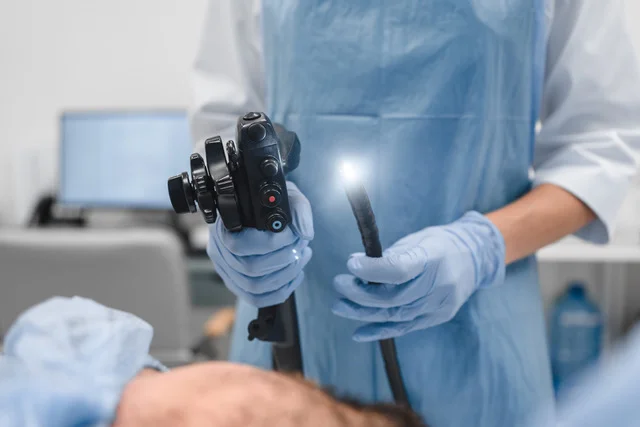
During an upper endoscopy, your gastroenterologist passes a thin, flexible endoscope through your mouth into the esophagus (the swallowing tube), the stomach and the duodenum — the first part of the small intestine. A light and a high-definition camera at the tip of the scope show the lining on a monitor in fine detail.
Through the same scope, your physician can take biopsies, remove polyps, treat bleeding and gently stretch (dilate) a narrowed esophagus. An upper endoscopy is more accurate than an X-ray for finding inflammation, ulcers and tumors, and it is the best way to find the source of bleeding in the upper digestive tract.
Biopsies taken during the exam can tell harmless tissue from abnormal or cancerous tissue, and can test for H. pylori, a common stomach infection.
Why you might need one
Your physician may recommend an upper endoscopy to investigate or monitor:
Heartburn or acid reflux that is frequent, severe or not helped by medication
Difficulty or pain when swallowing, or food that feels stuck
Upper abdominal pain, indigestion, nausea or vomiting that keeps coming back
Bleeding from the upper digestive tract — vomiting blood, or black, tarry stools
Unexplained anemia or weight loss
Hiatal hernia, ulcers or suspected tumors
Barrett’s esophagus, which needs regular monitoring
Suspected celiac disease or H. pylori infection
How to prepare
An upper endoscopy needs no bowel prep. What matters is that your stomach is completely empty — so your physician can see clearly, and so sedation is safe. Your SCDC instructions give the exact times for your appointment.
Stop eating at the time on your instructions — usually at least eight hours before your procedure
Clear liquids may be allowed until a few hours beforehand; stop all drinking at the cut-off time given
Take only the morning medications we have approved, with a small sip of water
Tell us in advance about blood thinners, insulin and other diabetes medications
GLP-1 medications such as Ozempic, Wegovy, Mounjaro, Zepbound, Trulicity or Rybelsus — they slow stomach emptying and can make sedation less safe. Injectable forms are typically stopped 7 days before your procedure and tablets 24 hours before.
Arrange for a responsible adult to drive you home
Leave jewelry at home, and be ready to remove dentures or other removable dental work
Your procedure day at SCDC
Sedation at SCDC is given by an anesthesiologist, or a nurse anesthetist working under an anesthesiologist’s direction — never by the physician performing your procedure. Your breathing, oxygen level, heart rhythm and blood pressure are monitored continuously from the moment sedation starts until you are awake in recovery.
-
Arrival
Come to our Diamond Bar center 45 minutes before your procedure time with your photo ID, insurance card, medication list and your driver.
-
Getting ready
A nurse reviews your health history and medications and starts an IV. Your gastroenterologist and your anesthesia provider both see you before the procedure begins.
-
The endoscopy
You lie on your left side and a small plastic mouth guard is placed to protect your teeth and the scope. Once you are asleep, your physician passes the endoscope through your mouth and examines the esophagus, stomach and duodenum, taking biopsies or performing a dilation if needed. Most exams take 10 to 20 minutes.
-
Recovery
You wake up in our recovery area and rest while the sedation wears off, usually 30 to 45 minutes.
-
Going home
Your physician explains the findings before you leave, and you receive a written report. Most patients are on their way home within about two hours of arriving.
After your upper endoscopy
A mild sore throat, bloating or cramping is common for a few hours and should steadily improve. Throat lozenges can help once the sedation has worn off.
You can usually eat and drink once you are fully awake — start with something light. Because of the sedation, do not drive, drink alcohol, operate machinery or sign important documents for the rest of the day. Most people return to work and normal activities the next day.
Call us — an on-call physician is reachable after hours — if you have:
Chest pain, or abdominal pain that is severe or getting worse
Trouble swallowing, or throat pain that is getting worse
Vomiting blood, or black, tarry stools
Fever or chills
Shortness of breath
Your results
Your physician will explain what was seen before you go home. If biopsies were taken, results are usually ready in seven to ten days, and we will contact you by phone or through the patient portal.
Depending on the findings, next steps may include medication, a follow-up visit, or periodic endoscopy to monitor a condition such as Barrett’s esophagus.
Common questions
Will I gag or have trouble breathing?
You will be asleep, so you will not feel the scope pass. It goes into the esophagus, not the windpipe, so it does not block your breathing — and your anesthesia provider monitors your breathing and oxygen throughout.
Does it hurt?
No. Most patients remember nothing of the procedure. Some have a mildly sore throat afterwards, which usually settles within a day.
Why can’t I eat beforehand?
Food in the stomach hides the lining from view and, more importantly, can be brought up and inhaled while you are sedated. An empty stomach keeps the procedure safe.
Can I have an upper endoscopy and a colonoscopy on the same day?
Yes. If you need both, they are commonly done one after the other under the same sedation. You follow the colonoscopy prep, which also covers the fasting needed for the upper endoscopy.
Will my insurance cover it?
Coverage depends on your plan and your deductible. Our billing office verifies your benefits and gives you a written estimate before your procedure.