- Examines
- The rectum and lower colon
- Procedure time
- About 10–20 minutes
- Prep
- Enemas, sometimes clear liquids
- Back to normal
- Usually the same day
What is a flexible sigmoidoscopy?
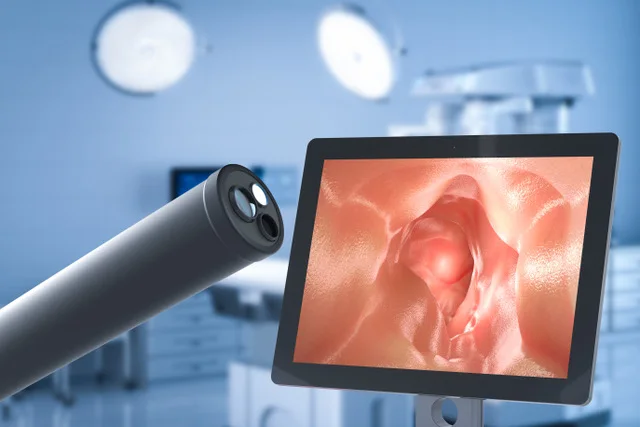
A flexible sigmoidoscopy lets your gastroenterologist look inside the rectum and the sigmoid colon — roughly the last two feet of the large intestine. It uses a sigmoidoscope: a short, thin, flexible tube with a light and a small camera at its tip that sends images to a monitor.
If your physician sees anything unusual, small tissue samples (biopsies) can be taken through the scope and checked under a microscope, and small polyps can be removed during the same exam.
Because it does not reach the rest of the colon, a flexible sigmoidoscopy cannot find polyps or cancers higher up. If a full examination is needed, your physician will recommend a colonoscopy instead.
Why you might need one
Your physician may recommend a flexible sigmoidoscopy to look into symptoms that are likely to come from the lower bowel, including:
Rectal bleeding, or blood in the stool
A change in bowel habits, or diarrhea that will not settle
Pain or discomfort in the lower abdomen or rectum
Suspected hemorrhoids, anal fissures or inflammation of the rectum
Checking on ulcerative colitis or other inflammatory bowel disease
Looking more closely at an area seen on an X-ray or CT scan
Sigmoidoscopy or colonoscopy?
The two procedures use similar instruments and are done in the same rooms at SCDC. The difference is how far the exam goes.
-
Flexible sigmoidoscopy
The rectum and sigmoid colon — about the lower third of the large intestine. An enema prep, a 10–20 minute exam, and little or no sedation. Best suited to symptoms that come from the lower bowel.
-
Colonoscopy
The entire colon and rectum. A full bowel prep and a 20–30 minute exam under sedation. The most complete test for colorectal cancer screening, and for symptoms that could come from anywhere in the colon.
How to prepare
The rectum and lower colon need to be empty so your physician can see the lining clearly. The prep is much lighter than for a colonoscopy, but it still matters — follow the instructions we give you for your appointment.
Most patients use one or two over-the-counter enemas before the exam, at the times shown on their instructions
You may also be asked to follow a clear liquid diet for 12 to 24 hours beforehand, or to take a mild laxative the night before
Clear liquids include water, clear broth, apple juice, plain tea or coffee without milk, light-colored sports drinks and gelatin — nothing red, blue or purple
Tell us in advance about blood thinners, iron, diabetes and GLP-1 medications
If you will be sedated, arrange for a responsible adult to drive you home
Your procedure day at SCDC
-
Arrival
Check in at our Diamond Bar center at the time on your instructions with your photo ID, insurance card and medication list. A nurse reviews your health history and answers any questions.
-
The exam
You lie on your left side with your knees drawn up. Your physician first does a brief, gentle rectal exam with a gloved finger, then passes the sigmoidoscope into the rectum. A little air is used to open the bowel so the lining can be seen — you may feel pressure, fullness or the urge to pass gas, which is normal.
-
Biopsies if needed
The lining is examined carefully as the scope is slowly withdrawn. If a biopsy is taken, you will not feel it. The whole exam usually takes 10 to 20 minutes.
-
Heading home
Without sedation, you can get dressed and go home soon afterwards, back to your usual diet and routine. If you had sedation, you rest in recovery until it wears off, and you will need a driver.
After your sigmoidoscopy
Mild cramping, bloating and passing gas are common for a few hours as the air leaves your colon. You can go back to your normal diet straight away.
A small amount of blood with your first bowel movement is normal, especially if biopsies were taken.
Call us — an on-call physician is reachable after hours — if you have:
Bleeding that continues, or more than a small amount
Severe or persistent abdominal pain
Fever or chills
Dizziness or weakness
Your results
Your physician will usually go over what was seen right after the exam. A normal (negative) result means no abnormalities were found in the part of the colon examined.
If polyps, inflammation or other abnormal tissue are found, biopsy results are usually ready in seven to ten days. Depending on the findings, your physician may recommend a colonoscopy so the rest of the colon can be checked.
Common questions
Will I be asleep?
Not necessarily. Many people have a flexible sigmoidoscopy without sedation, because it is short and the discomfort is usually mild. If you would prefer sedation, talk with your physician beforehand — you will then need a driver.
Is it painful?
Most patients describe it as uncomfortable rather than painful: a feeling of pressure, fullness or cramping that eases as soon as the scope is removed.
Can a sigmoidoscopy replace a colonoscopy for cancer screening?
It can be part of a screening plan for some people — usually repeated more often, and sometimes combined with a stool test — but it only examines the lower colon. For most patients a colonoscopy is the more complete choice. Your physician will help you decide.
Can I go back to work afterwards?
If you did not have sedation, usually yes — most people return to their normal routine the same day. After sedation, plan to rest for the remainder of the day.